


Our work at WILL assesses current trends to craft brands, designs, messaging, and positioning for clients that remains relevant and real in the future. So here’s some free predictions for 2026.
PREDICTION 1: Substack Plateaus
Edison Research says the number of new podcast listeners grew only by 5% from 2022 to 2023 and only up 3% from 2023 to 2024, and it continues to decline about 1 percent a year according to Podcaststatistics.com. These numbers are dubious as hell because they’re solicited by self-interested podcast media sales organizations, but take a look at Google Trends, and just ask yourself…when’s the last time you heard about a hit new podcast on the level of Serial, Martyr Made or Rogan?
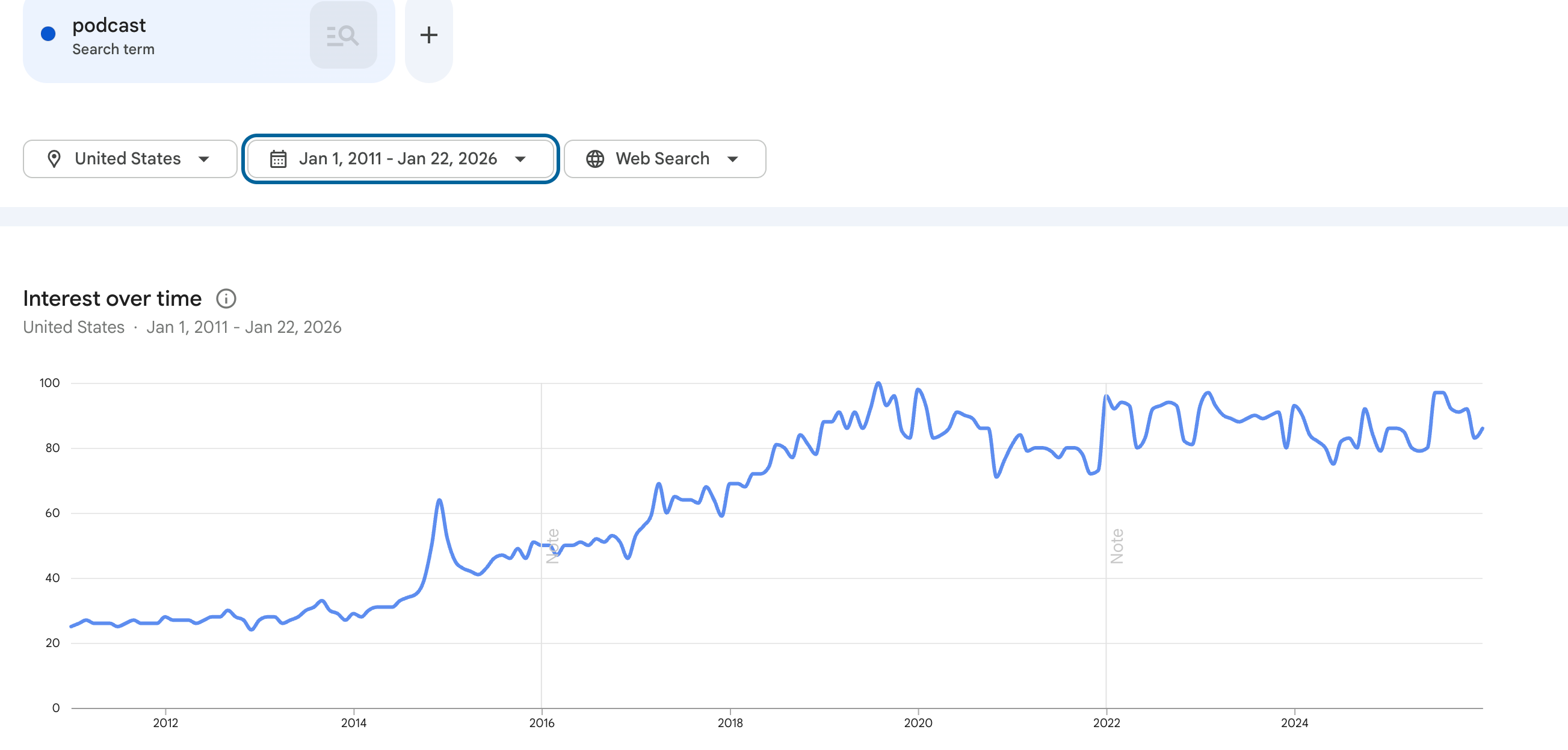
Like so many things in our current era, the entire podcasting industry seems to sit on shakier footing than the media would like us to believe.
Substack and podcasts obviously share quite a bit in common—independent creators spew unedited thoughts and ideas into the stratosphere and the market decides what’s worthy. Our bet is that the editorial layer is more important than this market gives it credit for. If Substack’s trajectory looks like anything podcasts’, the platform will flatline and flatline hard, the only question is a matter of when.
There is a phenomenon in technology space where sometimes they can become a victim of their own success; Facebook after all was once the cutting edge of social media and now its a laughing stock, despite its continued power and profitability. With regards to Substack, what was once an outpost of serendipitous discovery, is now more of a chore.
A recent perusal of the leading publications and “For You” category tabs illustrates that regime cronies, narrative slop and age old control mechanisms are now firmly entrenched in contrast to is position as a redoubt for more free speech minded folks, many of whom had been dubiously censored on other social media platforms, could congregate and thrive without suppression.
Don’t get us wrong, we’re not calling for or even predicting Substack’s demise, but it’s in a phase where we could start to see, if not an exodus, a certain leveling out of things. Perhaps this is an opportunity for something new to emerge?
PREDICTION 2: Hollywood’s Dead Cat Bounce
No one here is predicting a Hollywood bounce back to former heights and glory. The recent Golden Globes were a tragic affair that no one watched. Viewership was down to just over 7 million people; for context it was nearly 10 million just three years ago and averaged 20 million in the 2000’s.
And if comically bad messes One Battle After Another and Sinners are the best show business has to offer, well, not much else to say. The Academy Awards snubbed the best film of the year, Ari Aster’s Eddington, which tactfully illustrated the nuances and hypocrisies of the Covid Era. But here’s the kicker. Eddington was actually good. So it is possible. It can happen. And it will more frequently.
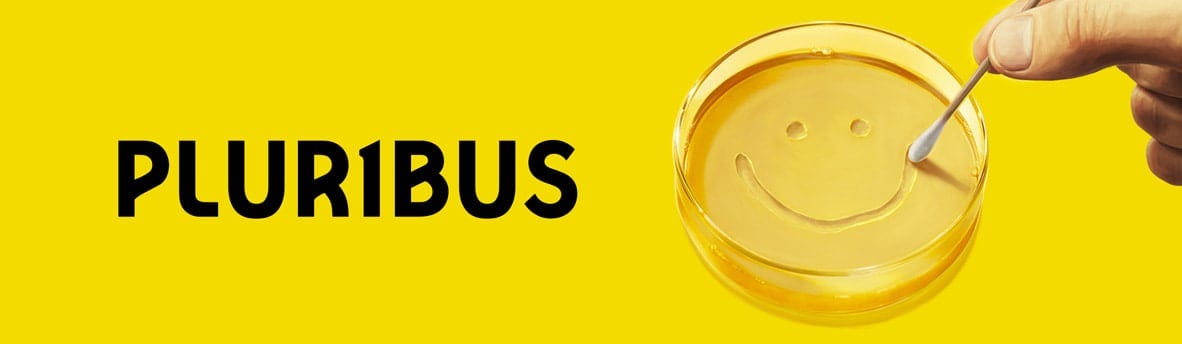
Vince Gilligan’s PLUR1BUS was another ray of hope that there’s great art always to be made and undoubtedly the man who brought us Breaking Bad and Better Call Saul has originated an engrossing new world that can easily live as a new multi season artwork. Looking ahead, Nolan’s Odysseus has already managed to capture the conversation, as we go back to the very beginnings of western culture itself. And then there’s Iñárritu’s forthcoming Digger starring Tom Cruise.
PREDICTION 3: The Economy Goes BOOM
The economy is heating up. We don’t need to trust Howard Lutnik’s dreamy GDP figures, or see the recent interest rate cuts to know that the American economy, though still riddled with serious pitfalls, is starting to really cook. Inflation seems under control and from the number of calls, re-ups and new investment we’re hearing about, the founders, entrepreneurs, investors and builders out there are telegraphing a sustained boom . Now whether that economic rocket ship reaches stage two separation and leaves the atmosphere is beyond our pay grade. We’ve all seen this before, the economy sucks for long enough that we get used to it, it gets a little better, and than craters again, people lose jobs, projects lose funding, people lose hope.
Rinse. Repeat.
Well, we hope this current economy is a real one because there are very few problems in America that CANNOT be solved by a sustained, real, actual not fake economic boom. Thoughts of civil war and government fraud and deportations will all fade away. As Calvin Coolidge famously said, “The Business of America is Business.” It’s hard to trust the Trump administration when they came out of the gates promising a golden age only to realize they needed at least the first year to staunch the bleeding from the disaster Biden created, but things are looking good and nothing will do more to heal America from its many self inflicted wounds, than simple, brute, clean, honest prosperity.
PREDICTION 4: Prediction Replaces Postmodernism
In a fascinating article by Alex Danco, Chief Editor for Venture Firm A16z, the author discusses how Prediction is the new superstructure that forms our world, in much the same way that Modernism and Post-Modernism helped us understand how history was changing, from the dominance of nation states and people’s into the globalized modern world we know today.
Danco observes that speculation has become pervasive—from meme stocks to sports betting to sneaker drops. The timing of when you engage with something has become essential to its meaning. He argues this represents people wanting to "feel something, even if it hurts" rather than consuming safe, personalized experiences. He goes on to say that all value creation now centers on prediction. Being "upstream in the information flow" and predictive rather than predicted becomes the new competitive advantage. Prediction markets and contracts may serve as organizing principles similar to how patents represented progress in the modern era.
The first observation I will make about popular society is how suddenly and decisively our culture moved towards speculation; not only in stocks and sports betting but also more broadly in life. Meme stocks might only be a few years old, but popular culture preceded them by a decade when Home & Garden TV programming became entirely about house flipping. Large swaths of the population now buy into the idea of “making your own luck” as a more literal virtue than it used to be.
This matters because there is now a meta-awareness (or meta-fantasy?) among the general public that our limited capital and attention could, in fact, find better places to go. There’s a driving energy in this world that everyone is doing this; and therefore, our attention each moment “predicts” the next one in a real sense. Not just forecasting it, but also setting the path dependence that leads us down the road and to a conclusion.
The second observation that I’ll make is how much social media now feels the same way that buying stocks does. Checking if your post is performing feels the same as checking whether your stock is up or down, and that tells you something important about your relationship to both activities.
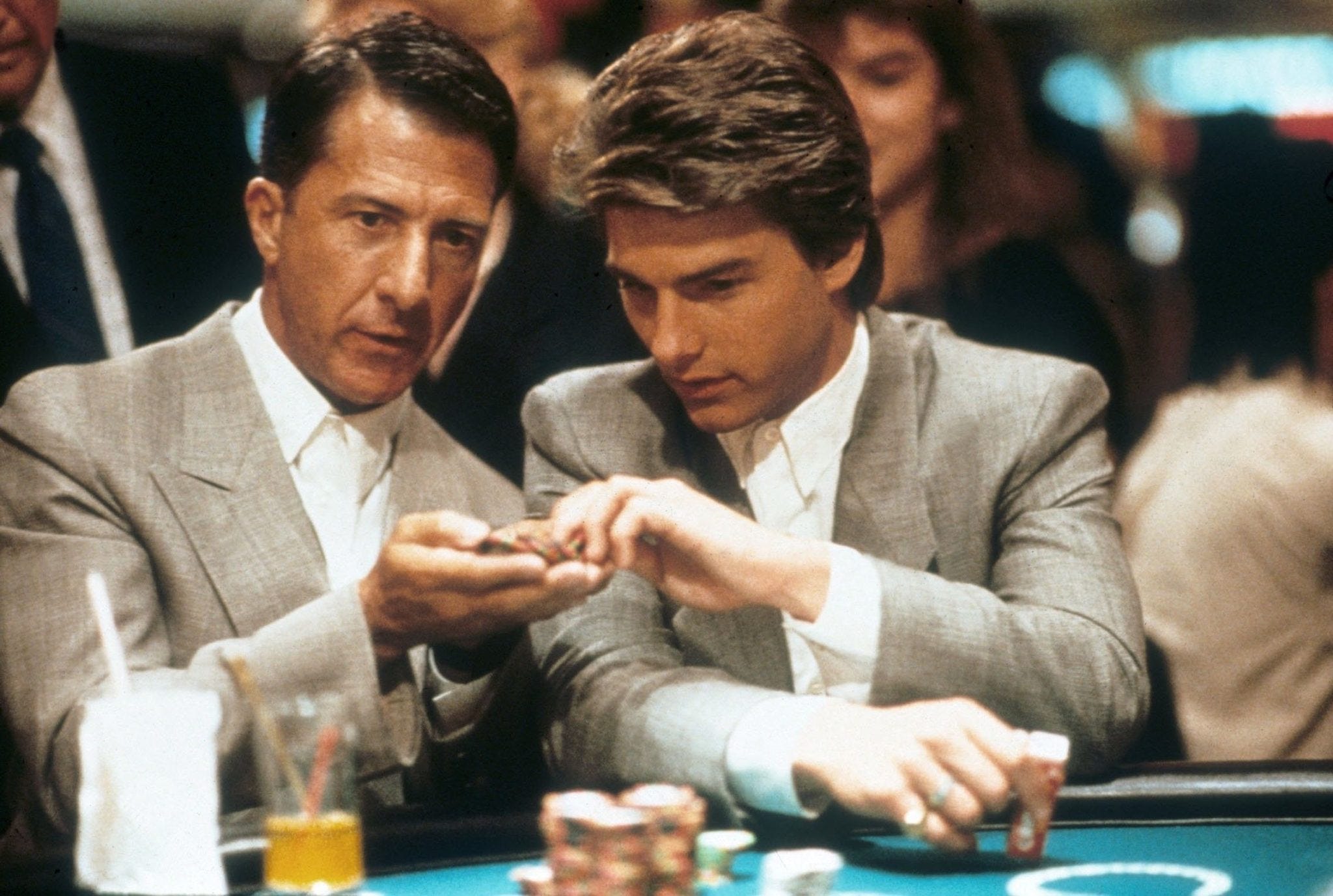
Our work with Polymarket is giving us undeniable access to these phenomenon, and the storytelling, marketing and branding implications are massive. Soon we’ll see short ai films, explainer videos and racist cartoons (it do be like that) on how humans, perhaps in conjunction with LLM’s and AI are deploying their genius (or autism depending on how you look at genius) to predict outcomes that both vastly differ from “gambling” and also strangely part of the same skill set. The internet is 50 million “Rain Man’s”.
For instance, when someone predicts that Maduro would be excised from power based on the call volume of pizza places or gay bars near the Pentagon, linking late night pizza orders and post shift elbow bending at bars, to unusual activity at the Department of War. Is it democratizing Vegas? Or are we on the very cusp of a hgue new breakthrough in human interaction and collaboration?
At WILL, we vie on the side of human creativity and flourishing, so while the world is changing and prediction becomes inculcated, we know to take a breath, never blackpill or panic, and trust in human ingenuity and goodness.
Btw, if you’ve got any tips or ideas for the year ahead, hit us up on X, we’re looking for exciting podcast guests outside the regular retinue, we want to hear from new voices, designers, technologists, builders, founders.
Here's some predictions:
The attempted color revolution in the USA will fail, but so will the Trump regime's counter-revolution (mostly).
The USA will then go into a soft-Balkanization, with people migrating to where they feel most comfortable. Some regions will thrive, others will fall halfway to third world shitholes.
We will enter a period where power devolves to state & local governments, controlled by networks of familiarity and patronage. Many foreigners will elect to leave, as the money dries up. The USA will slowly emerge from this (over decades) to be something much closer to what it was supposed to be from it's founding, but high-tech instead of agrarian.
Faith in many institutions will collapse, especially medicine/big pharma, leading to a new industry that examines botanicals, traditional medicine, etc. with a much more rigorous method, leading to a boom in health.
The Abrahamic religions will be shaken to their core as the truth comes out about the various traditions due to proper translations of the various 'sacred' texts. Christianity will experience a resurgence, but it will be entirely based on the actual teachings of Jesus (from the New Testament, and also other texts, e.g. The Gospel of Thomas).
New technology will start to leak out from various secret agencies as the ones keeping those secrets start selling bits off because they aren't getting paid in any meaningful way.
Eventually non-human sentient beings, technically advanced in many ways superior to ours, are officially admitted to exist, and will be revealed to be here on Earth (and may have always been here).
There's more, but those are some of the big ones.
The prediction-as-paradigm argument is fascinating, particularly how it reframes speculation as meaning-making rather than just gambling. That shift from consuming personalized, safe content to wanting predictive engagement makes sence when you see how fast prediction markets have mainstreamed. I've watched Polymarket go from niche to watercooler talk in under ayear, which suggests people actually crave the stake in outcomes, not just passive observation.